Telling Their Own Stories: The Indian Muslim American Voices Reshaping American Media from the Inside Out
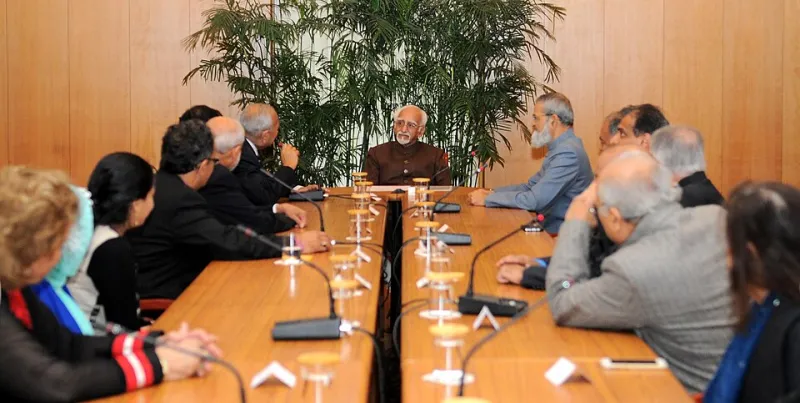
Photo: Vice President's Secretariat, GODL-India, via Wikimedia Commons
When Samira Hussain pitched her first longform feature to a national magazine editor, the response she received was polite, brief, and revealing. The story — an examination of how Indian Muslim American families were navigating post-9/11 surveillance culture — was "interesting," the editor wrote, but perhaps "too niche" for their readership. Samira, then twenty-four and fresh out of a journalism program at Northwestern, filed the rejection away and kept moving. That was twelve years ago. Today, her byline appears in three major publications, her newsletter has forty thousand subscribers, and the phrase "too niche" still makes her laugh.
"The thing is, the editor wasn't entirely wrong about the industry as it existed then," she says. "What they were wrong about was assuming it couldn't change."
It is changing. Slowly, unevenly, and not without cost — but it is changing. Across American journalism, podcasting, documentary filmmaking, and digital media, Indian Muslim Americans are building a presence that, a decade ago, would have been difficult to imagine. They are doing so not simply by assimilating into existing structures, but by actively reshaping what those structures look like and whose stories they consider worth telling.
A Landscape Built for Others
To understand why this moment matters, it is necessary to understand the landscape these creators are entering. American media has a long and well-documented history of marginalizing Muslim voices — and when it has engaged with Muslim communities at all, it has frequently done so through frameworks defined by security concerns, foreign policy debates, or cultural anxiety rather than by the lived realities of Muslim Americans themselves.
Indian Muslim Americans face an additional layer of invisibility. Within broader Muslim American representation, South Asian voices have historically been overshadowed by Arab American communities, who have had longer institutional roots in American media and advocacy. Within South Asian American representation, Indian Muslim voices are often displaced by Hindu majority narratives. The result is a community that finds itself, as one media critic put it, "doubly erased."
"There is no default template for us in American media," says Arjun Ansari, a documentary filmmaker based in Brooklyn whose recent short film about Indian Muslim identity in post-Modi America screened at three regional film festivals. "We don't fit the categories that newsrooms have already built. So either you reshape the category, or you build your own."
Breaking In — and Breaking Through
For those who have chosen to work within mainstream institutions, the experience is frequently one of negotiating visibility on two fronts simultaneously: fighting to get into the room, and then fighting to be heard once inside it.
Raheel Khan, a political correspondent at a mid-size digital news outlet in Washington, D.C., describes his early career as a constant exercise in managing other people's assumptions. "Editors would come to me when there was a story about a Muslim country or a terrorism angle," he recalls. "They assumed that was my expertise because of who I was, not because of what I actually knew. My actual expertise is domestic policy. It took years to redirect that."
This experience of being simultaneously sought out for one's identity and constrained by it is common among Indian Muslim American media professionals. The community's visibility has increased in some respects — particularly in the post-2016 political environment, when Muslim American stories became suddenly commercially viable for mainstream outlets. But visibility and representation are not the same thing, and many Indian Muslim American journalists note that increased coverage has not always translated into increased editorial control.
"Being a source is different from being a decision-maker," says Dr. Leena Mirza, a media studies scholar at Rutgers University who has written extensively on Muslim American representation. "The community is still largely being written about rather than writing. The question is who controls the frame."
The Independent Route: Podcasts, Newsletters, and Digital Platforms
Faced with the friction of institutional media, a significant number of Indian Muslim American creators have opted to build independent platforms — and the results have, in several cases, been remarkable.
The podcast Desi Deen, launched in 2021 by two Indian Muslim American women in Chicago, now draws an average of sixty thousand listeners per episode and has been cited in national publications as one of the most significant Muslim American media projects of the decade. Its founders, who declined to be interviewed for this piece but have spoken publicly about their work, have described their mission as creating content that assumes Indian Muslim American listeners are the audience, not the subject.
This distinction — between content made for the community and content made about it — is one that Indian Muslim American creators return to repeatedly. It represents a fundamental shift in the logic of representation: from waiting for mainstream validation to building the infrastructure for self-definition.
Samira Hussain's newsletter, which she launched during the pandemic after growing frustrated with the editorial limitations of her staff positions, exemplifies this approach. "I write for Indian Muslim American readers first," she says. "I'm not explaining our community to outsiders. I'm having a real conversation with people who share my reference points. That changes everything about how you write."
The Systemic Barriers That Remain
Progress, however, should not be mistaken for arrival. Indian Muslim American media professionals continue to face structural obstacles that are both persistent and, at times, difficult to name. Funding for independent media projects remains scarce, with many major journalism foundations still directing resources toward communities with more established institutional relationships. Newsroom diversity initiatives, while increasingly common, have often focused on racial categories that do not capture the specificity of Indian Muslim American experiences.
There is also the question of safety. Several Indian Muslim American journalists interviewed for this article described experiencing coordinated harassment campaigns after publishing work critical of Hindu nationalist politics — campaigns that they say are rarely taken seriously by the platforms on which they occur or the employers for whom they work.
"There is a cost to doing this work that most people outside the community don't see," says Arjun Ansari. "It's not abstract. It affects what you say, how you say it, whether you say it at all."
The Momentum Is Real
And yet. The energy among Indian Muslim American media professionals right now is, by most accounts, unlike anything the community has seen before. A generation that grew up watching their families misrepresented or ignored is now old enough, credentialed enough, and — crucially — networked enough to do something about it.
For Samira Hussain, the distance between that first rejection letter and today is measurable not just in bylines or subscriber counts, but in something harder to quantify: the sense that the story of her community is no longer solely in other people's hands.
"We are not waiting for permission anymore," she says. "That's the change. That's the whole thing right there."