Faith in Numbers: How Indian Muslim Americans Are Rewriting the Rules of Coalition Politics
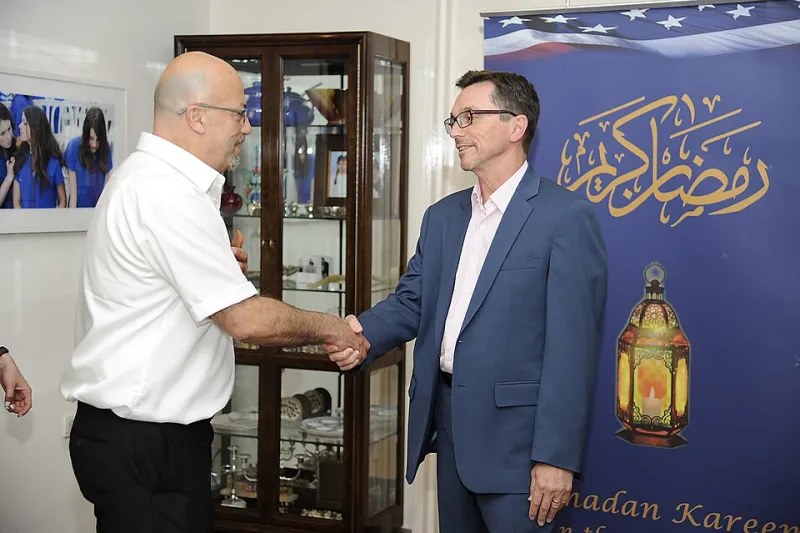
Photo: U.S. Embassy Tel Aviv, CC BY-SA 2.0, via Wikimedia Commons
For decades, the conventional wisdom held that American Muslims—and Indian Muslims in particular—were too fragmented, too politically cautious, and too preoccupied with assimilation to punch their weight in electoral politics. That assumption is now being dismantled, one coalition meeting at a time.
Across battleground states from Michigan to Georgia, Indian Muslim American civic organizations are doing something quietly radical: they are building durable, cross-faith political alliances that extend well beyond the mosque's front steps. These are not feel-good interfaith dinners. These are structured, strategy-driven partnerships with measurable electoral objectives—and they are beginning to deliver results.
The Architecture of Alliance
The groundwork for this shift was laid, in many ways, by crisis. The post-9/11 era forced American Muslim communities into a defensive crouch, but it also compelled organizations to seek allies outside their own circles. Then came the 2016 election, the travel ban, and the subsequent surge in anti-Muslim legislation at the state level. For Indian Muslim Americans—many of whom were simultaneously watching the rise of Hindu nationalist politics in India and its echoes within segments of the Indian American diaspora—the stakes felt existential on multiple fronts.
"We realized very quickly that we could not fight these battles alone," says a community organizer based in the Chicago suburbs who works with a coalition of South Asian civic groups. "The moment we started showing up for other communities—for immigration rights, for Black Lives Matter, for reproductive justice—those communities started showing up for us."
This reciprocity is the engine of the new coalition model. In Northern Virginia, Indian Muslim organizations affiliated with local Islamic centers have formalized partnerships with African American Baptist congregations and Korean American evangelical churches to coordinate voter registration drives and candidate forums. In the Houston metropolitan area, where the Indian Muslim population has grown significantly over the past decade, similar alliances have emerged with Latino Catholic parishes and secular labor unions representing immigrant workers.
Case Study: Michigan's Interfaith Electoral Infrastructure
Perhaps nowhere is this coalition-building more advanced—or more scrutinized—than in Michigan. The state's large Arab American and South Asian Muslim populations have historically operated in parallel rather than in concert. But since 2020, several Indian Muslim American-led organizations have worked deliberately to bridge that divide while simultaneously reaching across religious lines.
During the 2022 midterm elections, a coalition that included Indian Muslim civic groups, a Detroit-area Jewish progressive organization, and a network of Unitarian Universalist congregations coordinated phone banking and canvassing in three competitive state legislative districts. Two of those districts flipped. Coalition leaders are careful not to overstate causation, but the data on turnout in precincts targeted by the coalition was notably higher than in comparable districts where no such coordination existed.
The challenges, however, are real. Coalition partners do not always agree on policy priorities. Tensions over U.S. foreign policy—particularly regarding Israel and Palestine—have strained some alliances, requiring careful navigation and, at times, the willingness to disagree publicly without dissolving the partnership. "Unity does not mean uniformity," one coalition coordinator told Bhartiya Muslim. "We have learned to hold disagreement and solidarity at the same time."
The Secular Bridge
Not all of the coalition's most valuable partners are religious. Indian Muslim American organizations have increasingly recognized that secular progressive groups—environmental justice coalitions, reproductive rights organizations, and teachers' unions—share overlapping constituencies and complementary political goals.
This is a strategically significant development. By embedding themselves within the broader progressive infrastructure rather than operating as a single-issue religious bloc, Indian Muslim American groups gain access to organizing resources, donor networks, and political relationships that would otherwise be unavailable to them. It also complicates the efforts of political opponents who seek to marginalize Muslim voices by framing them as outside the American mainstream.
"When a Muslim American woman is standing next to a Methodist pastor and a Jewish labor organizer at a press conference about affordable housing, it changes the narrative," observes a political scientist who studies minority electoral behavior at a Midwestern research university. "It is harder to otherize a community that is visibly woven into the fabric of civic life."
Generational Momentum
Younger Indian Muslim Americans are both the beneficiaries and the drivers of this coalition-building moment. Many in their twenties and thirties came of age politically during a period of intense polarization and are less inclined than their parents' generation to treat political engagement as a liability. They are running for school boards, joining city planning commissions, and staffing campaigns in numbers that would have seemed improbable a generation ago.
This generational shift is also changing the internal culture of Indian Muslim American civic organizations. Institutions that once focused primarily on cultural preservation and religious programming are adding policy staff, launching political action committees, and developing candidate pipelines. The mosque is no longer merely a house of worship—it is, increasingly, a hub of civic infrastructure.
What Comes Next
The 2026 midterms and the subsequent presidential cycle will test the durability of these coalitions under conditions of maximum political pressure. The question is not whether Indian Muslim Americans will show up—the evidence increasingly suggests they will. The question is whether the alliances they have built will hold when the stakes are highest and the temptations to fracture are greatest.
History offers cautionary tales about coalitions that dissolved under stress. But it also offers examples of minority communities that built enduring political power precisely because they invested in relationships beyond their own boundaries. Indian Muslim Americans, it appears, are betting on the latter model—and the early returns are encouraging.
The ballot box, it turns out, is large enough for many faiths. The more interesting question is who is willing to share the space.