From the Margins to the Map: Indian Muslim Americans Forge a New Political Identity in Battleground America
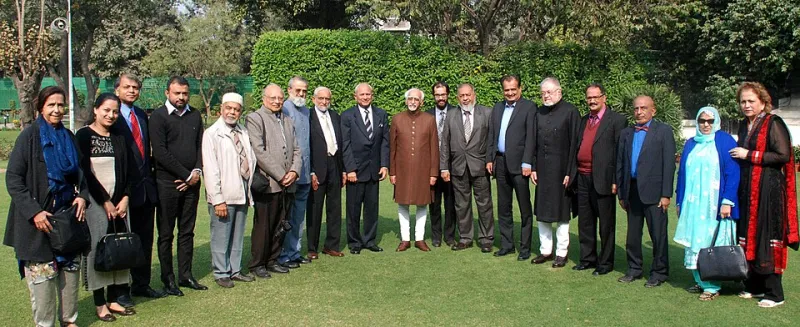
Photo: Vice President's Secretariat, GODL-India, via Wikimedia Commons
For much of the past two decades, Indian Muslim Americans occupied an uncomfortable space within the broader architecture of American political life. Frequently lumped into the catch-all category of "South Asian voters" or subsumed within larger Muslim American coalitions, their specific concerns — shaped by the intersection of immigrant experience, religious identity, and the particular trauma of post-9/11 surveillance — rarely received dedicated attention from campaign strategists or party operatives. That is changing, and it is changing fast.
In 2024, a generation of organizers, attorneys, educators, and small-business owners within the Indian Muslim American community are constructing something that has never quite existed before: an independent political infrastructure rooted in their lived experience, anchored in swing-state geography, and oriented around a policy agenda that is both distinctly their own and strategically aligned with broader progressive priorities.
Breaking the Bloc Mentality
The assumption that South Asian Americans vote as a unified bloc has long served as a convenient shorthand for political consultants, but it obscures more than it reveals. Indian Muslim Americans, who number an estimated 300,000 to 400,000 across the United States according to community demographic research, carry a political consciousness shaped by forces that differ substantially from those of their Hindu or Sikh counterparts.
"We are not a monolith, and we have never been," says Farrukh Siddiqui, a community organizer based in Dearborn, Michigan, who has spent the past three years building ward-level outreach networks targeting Indian Muslim households. "Our grandparents came from a country that partitioned along religious lines. Our parents navigated post-9/11 America. We have a very specific set of grievances and aspirations that deserve specific political attention."
Siddiqui's organization, which declined to be named ahead of a formal public launch, has registered over 2,400 new voters since January 2023 — the majority of them Indian Muslim Americans in their 20s and 30s who had previously been disengaged from electoral politics. The effort is part of a broader pattern visible across several battleground states.
In Georgia, where the 2020 presidential election was decided by fewer than 12,000 votes, Indian Muslim American networks in the Atlanta metro area have partnered with Black-led civil rights organizations to conduct joint voter mobilization drives. In Pennsylvania, community members in the Philadelphia suburbs have established policy working groups focused specifically on education equity and anti-discrimination protections in public institutions. In Arizona, a coalition of Indian Muslim American professionals has begun holding candidate forums that require participants to address questions about Islamophobia, immigration policy, and economic access — questions that mainstream campaign events rarely invite.
A Policy Agenda Rooted in Experience
What distinguishes this emerging political mobilization is its specificity. Rather than attaching to broad partisan platforms, Indian Muslim American organizers are articulating a focused agenda built around three pillars: civil rights enforcement, educational opportunity, and economic justice.
On civil rights, the community's concerns are informed by a documented history of federal surveillance programs — including the FBI's mapping of Muslim communities and the NYPD's now-discontinued Demographics Unit — that disproportionately affected Indian Muslim Americans. Advocates are pushing for robust oversight mechanisms, expanded protections under the Civil Rights Act, and greater accountability for law enforcement agencies that engage in religious profiling.
On education, Indian Muslim American families report navigating school environments where their children frequently encounter both overt Islamophobia and a curriculum that renders their heritage invisible. Community leaders are advocating for inclusive curricula, stronger anti-bullying enforcement, and expanded access to scholarship programs for first-generation college students.
On economic justice, the conversation centers on small-business access to capital, equitable treatment in federal contracting, and protections for halal-compliant workers in industries ranging from food service to finance.
"These are not abstract policy positions," explains Dr. Nadia Rahman, a political scientist at a mid-Atlantic university who studies Muslim American civic participation. "They emerge directly from the material conditions of this community's daily life. When you ground political engagement in that kind of specificity, you build something durable."
Coalition Without Co-optation
Perhaps the most significant strategic shift underway is the community's approach to coalition-building. Rather than seeking inclusion within pre-existing South Asian political structures — which often prioritize Hindu nationalist-aligned donors and organizations — Indian Muslim American organizers are forging lateral alliances with Arab American, Black, and Latino communities around shared policy concerns.
This cross-ethnic coalition model has already produced measurable results. In Michigan, coordinated outreach between Indian Muslim and Arab American networks contributed to higher-than-average turnout among Muslim voters in the 2022 midterms. In Virginia, a joint initiative between Indian Muslim American professionals and African American faith communities successfully lobbied a county school board to adopt stronger anti-discrimination policies.
The approach is not without tension. Some within the broader South Asian American community view the independent organizing with suspicion, concerned that it fragments a coalition that derives its influence from numbers. Others worry about the political risks of aligning too closely with Arab American advocacy groups on issues like U.S. foreign policy in the Middle East.
But organizers argue that the alternative — remaining politically invisible within coalitions that do not reflect their priorities — carries far greater long-term costs.
Data, Discipline, and the Long Game
Underpinning this new political infrastructure is an increasingly sophisticated use of data. Community organizations are building voter files that allow them to identify Indian Muslim American households at the precinct level, track engagement, and target outreach with the kind of precision that was previously available only to well-funded campaigns.
The effort reflects a broader maturation of civic capacity. Whereas earlier generations of Indian Muslim American political engagement were often reactive — mobilizing in response to hate crimes or discriminatory legislation — today's organizers are playing offense, building long-term relationships with elected officials and establishing the community as a reliable, organized constituency that candidates must actively court.
The road ahead is neither simple nor guaranteed. Persistent underrepresentation in elected office, limited access to major donor networks, and the ongoing challenge of engaging community members who remain skeptical of American political institutions all present real obstacles.
But the trajectory is unmistakable. Indian Muslim Americans are no longer waiting to be discovered by campaigns that treat them as an afterthought. They are building the infrastructure, forging the coalitions, and articulating the agenda that will define their political presence for decades to come.
In the calculus of battleground-state democracy, that is not a footnote. That is a force.