One Community, Many Homelands: How Regional Loyalties Are Redrawing the Map of Indian Muslim America
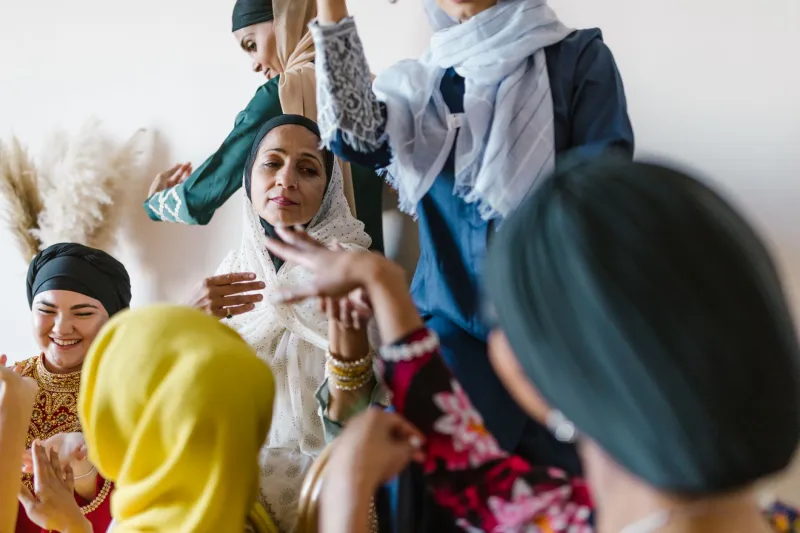
On a Saturday afternoon in Jackson Heights, a Sylheti cultural association is hosting its annual gathering — biryani fragrant with mustard oil, Bangla folk songs drifting through a rented community hall, and a lively debate about whether their local mosque should conduct Friday khutbahs in English, Bangla, or both. Forty miles south in Edison, New Jersey, a Gujarati Muslim business network is convening its quarterly lunch, where conversations about halal entrepreneurship blend seamlessly with discussions of caste discrimination and political representation. Meanwhile, in Fremont, California, a Hyderabadi Muslim cultural group is organizing a fundraiser that doubles as a voter registration drive.
These are not isolated snapshots. They are evidence of a quiet but consequential transformation unfolding inside Indian Muslim America — one in which the gravitational pull of regional identity is growing stronger, and the vision of a unified pan-Indian Muslim community is being tested as never before.
The Mosaic Beneath the Label
The term "Indian Muslim" has always been a convenient shorthand that obscures an extraordinary degree of internal diversity. Indian Muslims in the United States trace their origins to communities separated by language, cuisine, theology, caste history, and centuries of distinct political experience. A Kashmiri Muslim family that fled the valley during the 1990s carries a fundamentally different set of wounds, memories, and political instincts than a Bohra merchant family from Surat whose ancestors navigated colonial trade networks with considerable autonomy. A Mappila Muslim from Kerala brings a coastal, syncretic cultural tradition that shares almost nothing aesthetically or linguistically with a Mewati Muslim from Haryana.
For decades, the pressures of immigration — the need for mutual aid, the desire for communal solidarity in an unfamiliar country, and the external perception of Indian Muslims as a single category — encouraged these groups to paper over their differences. Mosques became catch-all institutions. Community organizations adopted broad, inclusive charters. Pan-Indian Muslim identity served a practical purpose, even if it never fully reflected lived reality.
But as the Indian Muslim population in America has grown, matured, and diversified across multiple generations, the utility of that umbrella identity is being openly questioned — and in some quarters, actively dismantled.
The Sylheti Case: Language as Political Boundary
Perhaps no regional community illustrates this dynamic more vividly than Sylheti Muslims, who form a substantial portion of the Bengali Muslim population concentrated in New York City, particularly in the Bronx, Queens, and parts of Brooklyn. Originating from the Sylhet division of what is now Bangladesh — though a significant number trace roots to the Indian state of Assam — Sylheti Muslims in America occupy a genuinely ambiguous identity space. They are Indian Muslims, Bangladeshi Muslims, Bengali Muslims, and Sylheti speakers all at once, and these categories do not always map neatly onto one another.
This complexity has political consequences. When Indian Muslim advocacy organizations attempt to build coalitions, they frequently discover that Sylheti community leaders are simultaneously embedded in Bangladeshi American political networks, South Asian American coalitions, and borough-level Democratic Party structures that have little to do with Indian Muslim identity as such. Their political allegiances are layered and sometimes competing. Recruiting them under a pan-Indian Muslim banner requires an acknowledgment of that layered identity — something that broader coalitions have not always been willing to provide.
"We are not a subdivision of Indian Muslim America," one Sylheti community organizer in the Bronx told us. "We have our own history, our own political concerns, and frankly our own relationship to India that is complicated in ways that other communities don't always understand."
Gujarat, Hyderabad, Kashmir: Three Political Vocabularies
The divergence is not limited to Bengali Muslims. Gujarati Muslims — particularly those from trading communities such as the Memons, Bohras, and Khojas — tend to bring a politically cautious, economically oriented approach to community organizing. Their networks in New Jersey, Illinois, and California are often anchored in business associations and religious institutions with strong internal governance traditions. Their relationship to Indian politics is shaped by the trauma of the 2002 Gujarat riots, which created a particular kind of political wariness toward Hindu nationalist movements and a corresponding investment in American civil rights frameworks.
Hyderabadi Muslims, by contrast, carry the memory of the 1948 police action — the forcible annexation of the Nizam's state into the Indian Union — as a founding political grievance that continues to inflect how they engage with questions of Muslim political power and minority rights. Their cultural institutions in Texas, Virginia, and California often function as both preservation societies and advocacy platforms, with a distinctive emphasis on Deccani culture, Urdu literary tradition, and a form of Muslim political identity that is proudly regional rather than generically pan-Indian.
Kashmiri Muslims in America occupy perhaps the most politically charged position of all. Their community's experience of military occupation, enforced disappearances, and the revocation of Article 370 in 2019 has produced a diaspora that is, by necessity, intensely political. Kashmiri American advocacy organizations — several of which are headquartered in the Washington, D.C. metro area — operate with a level of political urgency and international focus that can make coalition-building with other Indian Muslim groups genuinely difficult. Their primary political frame is human rights and self-determination; the priorities of, say, a Gujarati Muslim small business owner in Edison may feel remote by comparison.
Unity as Strategy, Diversity as Strength
None of this fragmentation is necessarily fatal to the project of Indian Muslim American advocacy. In fact, a growing number of community leaders argue that acknowledging regional diversity honestly is a precondition for building coalitions that actually hold.
"The mistake has been to treat pan-Indian Muslim identity as a starting point rather than an achievement," said one Washington-based policy advocate who works across multiple Indian Muslim communities. "You cannot build real solidarity by asking people to suppress what makes them who they are. You build it by finding the overlapping interests that exist despite the differences."
There is evidence that this more sophisticated approach is gaining traction. Several regional Indian Muslim organizations have begun collaborating on shared legislative priorities — particularly around immigration policy, anti-Muslim discrimination, and foreign policy toward South Asia — while maintaining distinct cultural and organizational identities. The model resembles, in some ways, the coalitional politics practiced by Latino advocacy groups in the United States, where pan-ethnic solidarity coexists with robust Puerto Rican, Mexican American, and Cuban American institutional identities.
The Question No One Wants to Answer
Still, a harder question lurks beneath the strategic discussions: Is pan-Indian Muslim identity in America a genuinely shared experience, or is it primarily a response to external pressure — a category imposed by a society that does not distinguish between a Kashmiri refugee and a Bohra entrepreneur?
The answer is probably both, and that ambivalence is worth sitting with. Shared experiences of post-9/11 surveillance, workplace discrimination, and the rise of Hindu nationalist politics in both India and the United States have created genuine common ground. But so have the persistent differences in language, theology, caste, class, and political memory that regional identities carry.
The most honest version of Indian Muslim America is not a unified bloc marching in lockstep. It is a collection of distinct communities, each with its own history and its own relationship to this country, sometimes finding common cause and sometimes pulling in different directions. Learning to hold that complexity — to organize across difference without erasing it — may be the defining political challenge for this community in the years ahead.