Triple Burden: When Being Indian, Muslim, and Immigrant Means Fighting Three Battles at Once in the American Workplace
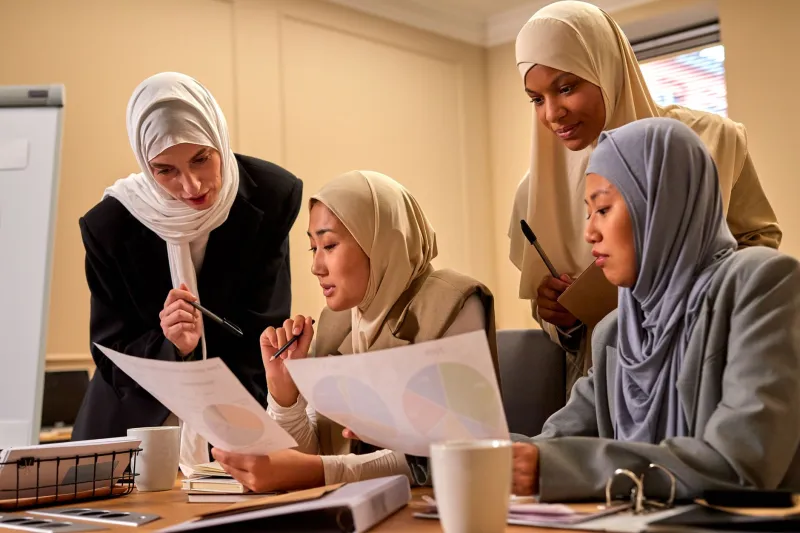
When Zainab Merchant walked into her first performance review at a mid-sized financial services firm in Chicago, she carried with her a graduate degree from a Big Ten university, two years of flawless quarterly numbers, and a quiet dread she had learned not to name aloud. Her manager's feedback was polished, almost clinical — words like "communication style" and "cultural fit" appearing with a frequency that told her everything the formal language would not. She was passed over for a promotion that went to a colleague with a shorter track record.
"I am never just one thing to the people in that building," Merchant, now 34, told Bhartiya Muslim. "I am Muslim when there is news about a bombing somewhere. I am Indian when someone wants to make a joke about my accent. I am an immigrant when the conversation turns to hiring policy. I am never simply a colleague."
Her experience is neither isolated nor anecdotal. Across industries — from technology corridors in Silicon Valley to hospital systems in the mid-Atlantic, from law firms in New York to government contractors in the Washington suburbs — Indian Muslim Americans are describing a layered professional reality that mainstream diversity, equity, and inclusion conversations have been conspicuously slow to acknowledge.
The Architecture of Compounded Bias
Discrimination scholars have long documented what legal theorist Kimberlé Crenshaw termed intersectionality — the phenomenon by which overlapping identities generate forms of marginalization that cannot be reduced to any single category. For Indian Muslim Americans, that framework illuminates something particularly acute.
They face the post-9/11 suspicion that has shadowed Muslim Americans across all demographic lines for more than two decades. They simultaneously encounter the model minority myth applied to South Asians — a double-edged assumption that positions them as technically competent but culturally subordinate, unlikely candidates for leadership roles. And as immigrants or children of immigrants, many carry accent-based bias, name discrimination in hiring pipelines, and the compounding disadvantage of professional networks built without the generational scaffolding available to native-born peers.
"What makes this population particularly vulnerable," said Dr. Ayesha Siddiqui, a researcher at a Chicago-based civil rights organization who studies workplace discrimination among Muslim Americans, "is that each layer of their identity activates a different bias in the perceiver. The biases do not simply add together. They interact, they reinforce each other, and they produce outcomes that are worse than any single bias would predict."
What the Data Suggests — and What It Misses
Employment discrimination data in the United States is notoriously difficult to disaggregate. Federal Equal Employment Opportunity Commission filings track religion and national origin as separate categories, but do not capture the intersection of the two, nor do they parse the specific experience of Indian-origin Muslims as distinct from broader Muslim American or South Asian American populations.
A 2023 survey conducted by the Institute for Social Policy and Understanding found that Muslim Americans reported workplace discrimination at rates significantly higher than the general population, with particular concentrations in hiring, promotion, and managerial evaluation. But advocates argue that even this data flattens the experience of communities like Indian Muslim Americans, whose grievances fall between the cracks of categories designed for simpler identities.
Workplace discrimination attorney Farrukh Ansari, who practices in New Jersey and has represented South Asian Muslim clients in employment disputes, describes a pattern he sees repeatedly. "The employer's defense is almost always the same: there is no direct evidence of religious animus, there is no direct evidence of national origin bias. And technically, they may be right about each claim in isolation. But the totality of what happened to my client — the exclusion, the retaliation, the coded language in reviews — only makes sense when you hold all of those identities together."
That evidentiary gap, he argues, is not accidental. It reflects legal frameworks built for a world of singular, legible identities.
The Invisible Tax of Hypervigilance
Beyond formal discrimination, professionals describe a subtler and in some ways more exhausting burden: the constant labor of managing perception across multiple axes simultaneously.
Imran Qureshi, a software engineer in the Seattle area, describes the mental calculus that begins before he enters any professional space. "I think about my name on an email. I think about whether to mention Eid when I ask for time off, or just call it a personal day. I think about whether wearing a kurta to a company cultural event will make me seem like I am performing my identity, or whether not wearing it will feel like I am erasing it. None of my non-Muslim colleagues are doing this math."
HR professionals who work with diverse employee populations acknowledge the phenomenon, though some express frustration at their own institutions' limited tools for addressing it. "Our DEI training was built around Black and white dynamics, with some gender content added later," said one HR director at a large healthcare system in Texas, who asked not to be named given her employer's sensitivity around these issues. "When I try to raise the specific experiences of South Asian Muslim employees, I get blank stares. There is no module for this. There is no vocabulary for this in most corporate DEI programs."
The Silence That Compounds Everything
Perhaps the most consequential dimension of this crisis is the silence surrounding it. Indian Muslim Americans, shaped by cultural norms that prize professional discretion and wary of being perceived as disruptive, frequently choose not to report discrimination or raise concerns through internal channels.
That silence, advocates warn, feeds a dangerous illusion of inclusion. "When no one complains, leadership assumes there is no problem," said Merchant, who has since moved to a different firm and serves informally as a mentor to younger South Asian Muslim professionals in her city. "But the absence of complaints does not mean the absence of harm. It means the harm has become normalized."
Community organizations are beginning to respond. Several Indian Muslim American professional associations in cities including New York, Chicago, and Houston have launched peer support networks and know-your-rights workshops specifically tailored to workplace discrimination. Advocacy groups are pushing for more granular data collection in federal employment surveys. And a small but growing cohort of attorneys is developing litigation strategies that treat intersectional discrimination as a coherent legal theory rather than a collection of separate claims.
Building the Case for a New Framework
The broader argument being made by advocates is not merely procedural. It is a demand for recognition — that the experience of Indian Muslim Americans in professional America is specific, is serious, and deserves frameworks adequate to its complexity.
"The American workplace was not designed with us in mind," said Dr. Siddiqui. "The DEI infrastructure that exists today was built in response to other struggles, and we are grateful for the ground those struggles cleared. But we cannot fit our experience into categories that were never made for us. We have to build our own."
For Zainab Merchant, that building is already underway, one conversation at a time. "Every time I tell a younger person what I went through, and they say, 'That happened to me too, I thought it was just me' — that is the beginning of something," she said. "The invisibility only works if we stay invisible. We are done with that."