Sacred Principles, American Ground: How Indian Muslim Families Are Negotiating Faith, Law, and the Next Generation
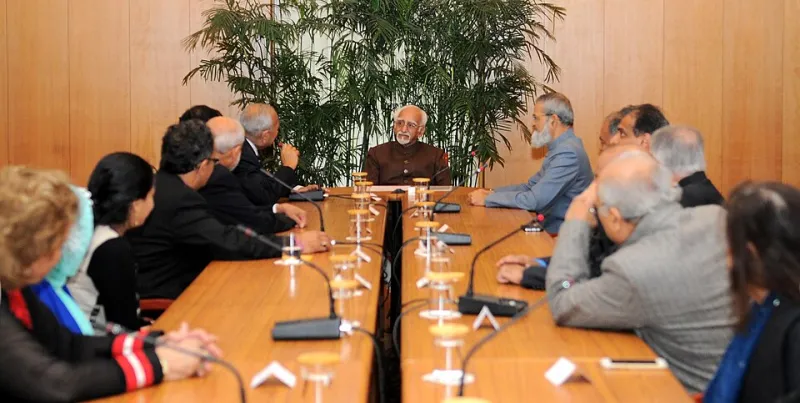
Photo: Vice President's Secretariat, GODL-India, via Wikimedia Commons
The argument, as Nadia recalls it, started over a homework assignment.
Her fourteen-year-old daughter had come home from a public school in the Atlanta suburbs with a health class worksheet that touched on topics the family considered inconsistent with their Islamic values. What followed was not a simple parent-teacher conference. It became, over the course of several weeks, a meditation on the distance between two worlds that Nadia—who immigrated from Hyderabad in the late 1990s—had spent two decades trying to bridge.
"I did not come to America to abandon who I am," she says, speaking on condition that her last name not be used. "But I also did not come here to make my daughter feel like she does not belong. I am always trying to find the middle. I am not sure the middle always exists."
Nadia's dilemma is not unique. Across the United States, Indian Muslim American families are navigating a set of tensions that are at once intensely personal and unmistakably political. The intersection of Islamic legal and ethical tradition with American civil law, public education policy, and secular civic culture is generating friction—and, increasingly, organized political responses—that deserve serious attention.
The Misunderstood Word
Few terms in American political discourse are as routinely distorted as "sharia." In the years following September 11, a cottage industry of anti-Muslim advocacy groups built entire legislative campaigns around the specter of Islamic law displacing the U.S. Constitution. More than two dozen states introduced some version of "anti-sharia" legislation. The framing was almost entirely fictional—no American Muslim organization has ever sought to impose religious law on non-Muslims or to supplant civil courts—but the damage to public understanding was lasting.
For Indian Muslim Americans, the caricature is particularly galling. The vast majority understand sharia not as a political program but as a personal and communal framework for ethical living: guidance on prayer, fasting, charitable giving, family relations, and moral conduct. "It is closer to how an observant Catholic might think about natural law," explains a scholar of Islamic jurisprudence at a U.S. university who has written extensively on Muslim American legal experience. "It informs conscience. It does not replace the Constitution."
Yet the gap between that lived reality and the public perception of Islamic law has real consequences—for how Indian Muslim Americans are treated in workplaces, in courts, and in the political arena. It has also shaped how families talk, or decline to talk, about their faith in public settings.
The Generational Fault Line
If first-generation Indian Muslim immigrants often responded to this climate by keeping their religious lives relatively private, their American-born or American-raised children are charting a different course. Many young Indian Muslim Americans are more openly assertive about their identity, less willing to compartmentalize their faith, and more fluent in the language of civil rights and constitutional law.
This generational divergence is not always comfortable. Parents who survived by being unobtrusive sometimes struggle to understand children who wear their identity as a form of resistance. Children, in turn, can find their parents' caution frustrating—even as they recognize the pragmatic wisdom behind it.
"My parents came here and worked incredibly hard and kept their heads down," says Imran, a twenty-six-year-old software engineer in the San Francisco Bay Area whose family emigrated from Gujarat. "I respect that. But I am not willing to pretend to be less than I am to make other people comfortable. That is not the America I believe in."
The tension plays out in specific, concrete ways: debates over whether daughters will wear hijab in high school; disagreements about whether children should attend Islamic weekend schools alongside public school; disputes over marriage—whether within the community or outside it—and what role Islamic family law should play in those arrangements.
When Private Becomes Political
What makes these family negotiations politically significant is that they do not stay private for long. Decisions that Indian Muslim American parents make about their children's education, healthcare, and religious upbringing increasingly intersect with contested policy terrain.
Consider the landscape of public education. Debates over curriculum content—sex education, the teaching of world religions, library book selections—have become flashpoints in school districts across the country. Indian Muslim American parents have found themselves in complex, sometimes uncomfortable alliances: occasionally aligned with conservative religious groups on specific curricular objections, while simultaneously opposing those same groups on issues of civil rights, immigration, and anti-discrimination policy.
"We do not fit neatly into anyone's political box," says a mother of three who serves on a parent advisory board in a New Jersey school district. "We have values that some people would call traditional. We also have values around justice and inclusion that are deeply Islamic. People do not always know what to do with that combination."
Similarly, questions about religious accommodation in workplaces and schools—the right to pray during work hours, to observe religious holidays, to wear religious dress—have generated a body of litigation and policy advocacy that directly involves Indian Muslim American communities. Organizations like the Council on American-Islamic Relations have won important legal victories in these areas, but the battles are ongoing and the outcomes uneven.
Raising Children in the Hyphen
Perhaps the most profound dimension of this negotiation concerns identity itself. How do Indian Muslim American parents raise children who are fully, confidently American without losing the religious and cultural inheritance that gives their family its particular shape and meaning?
There is no single answer. Some families lean heavily on Islamic school networks and community institutions to create a parallel world of belonging. Others integrate more fully into mainstream American life, trusting that their children will find their own relationship with faith. Many occupy the vast, complicated middle ground—negotiating each decision individually, making peace with inconsistency, and accepting that the hyphen in "Indian Muslim American" is not a compromise but a description of something genuinely complex.
"I want my children to know who they are," Nadia says, returning to the conversation that began with that homework assignment. "I want them to know their prayers, their history, their language. And I want them to be good Americans—to vote, to serve, to contribute. I do not think these things are in conflict. But I will spend the rest of my life proving it."
In that daily act of proof, she is far from alone. And the country, whether it recognizes it or not, is watching.