Love Across the Line: How Indian Muslim American Families Are Renegotiating the Terms of Belonging
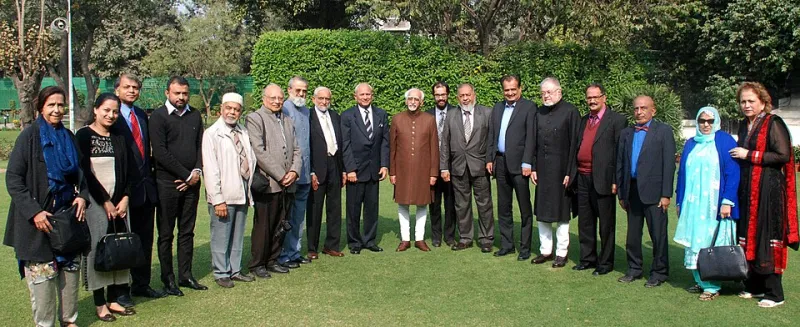
Photo: Vice President's Secretariat, GODL-India, via Wikimedia Commons
In a suburban living room in Naperville, Illinois, Zara Siddiqui, twenty-six, sits across from her mother and tries, for what she says is perhaps the hundredth time, to explain why she is in love with a man named Daniel. He is kind, she says. He is respectful. He has met her family, brought mithai, removed his shoes at the door. Her mother listens carefully. Then she asks the same question she always asks: But is he Muslim?
This exchange, or some version of it, is playing out in Indian Muslim American households from Fremont to Dearborn to Jersey City. It is not a new conversation, but it is an increasingly urgent one — shaped by the particular pressures of diaspora life, generational change, and an American cultural landscape that has long celebrated the idea that love transcends every boundary.
The Weight of Expectation
For many Indian Muslim American parents, the concern about interfaith relationships is rarely about prejudice alone. It is, more often, about continuity — the preservation of a religious and cultural identity that was carried across oceans at considerable cost. First-generation immigrants who built mosques, organized Eid celebrations, and sent their children to weekend Islamic school did so with a specific vision of the future in mind. A marriage outside the faith can feel, to them, like a rupture in that vision.
"My parents didn't sacrifice what they sacrificed so that everything would just dissolve in one generation," says Imran Qureshi, a forty-eight-year-old physician in Houston whose eldest daughter is currently in a long-term relationship with a non-Muslim man. "I'm not a bigot. I just want my grandchildren to know who they are."
This tension between love as a personal choice and marriage as a communal institution is not unique to Indian Muslim Americans. But the community's particular position — straddling South Asian cultural conservatism, Islamic theological tradition, and the American ethos of individual autonomy — gives it a distinct texture.
Dr. Nadia Rahman, a sociologist at the University of Michigan who studies Muslim American family dynamics, notes that Indian Muslim Americans occupy a uniquely complex space. "They are navigating three overlapping identity systems simultaneously," she explains. "South Asian cultural norms, which are often quite strict about endogamy. Islamic religious guidelines, which permit Muslim men to marry People of the Book but are more restrictive for women. And American social norms, which actively celebrate romantic freedom. The friction between those systems is real and unavoidable."
What the Younger Generation Is Actually Saying
Among Indian Muslim Americans in their twenties and thirties, the discourse around interfaith relationships has shifted considerably. Many grew up in diverse American schools and universities where cross-cultural friendships were the norm. Their social circles are often religiously mixed. Their understanding of identity is fluid in ways their parents' was not.
For many, the question is not whether to date or marry outside the faith, but how to do so while honoring the parts of their heritage that genuinely matter to them. Fatima Malik, twenty-nine, a graduate student in Boston who is engaged to a Hindu man, describes her approach as one of intentional negotiation rather than rejection. "I haven't left Islam," she says firmly. "I pray. I fast. I want our children to know both traditions. But I also fell in love with a specific person, and I refuse to believe that makes me less Muslim."
Not everyone in her community agrees. Fatima describes losing two close friendships when her engagement became public, and notes that her family's mosque has been conspicuously silent — neither welcoming nor outright hostile, but simply absent. "The silence is its own message," she says.
Others, however, have found more support than they expected. Khalid Ahmed, thirty-two, a software engineer in Seattle who married a Mexican American Catholic woman three years ago, says his parents' initial resistance gradually softened after his wife began learning about Islamic customs and participating in family traditions. "She fasts with me sometimes during Ramadan. She knows the dua before meals. My mom still wishes things were different, but she loves her daughter-in-law. Life is complicated."
The Gender Asymmetry No One Wants to Talk About
One of the more uncomfortable dimensions of this conversation involves the persistent double standard that many Indian Muslim American women experience. Classical Islamic jurisprudence permits Muslim men to marry Jewish or Christian women while generally prohibiting Muslim women from marrying non-Muslim men. In practice, this theological distinction often translates into social tolerance for the choices of sons that is simply not extended to daughters.
"My brother dated a white girl for two years and nobody said a word," says one woman in her late twenties who asked to remain anonymous. "The moment I told my family I was seeing someone who wasn't Muslim, it was treated like a crisis. The rules are different for us, and everyone knows it, but no one wants to say it out loud."
Dr. Rahman confirms that this asymmetry is well-documented in her research. "Women in these communities often bear a disproportionate share of the burden of cultural preservation," she says. "Their choices are read as communal statements in a way that men's choices are not."
How Communities Are Adapting
Across the country, some Indian Muslim American institutions are beginning — slowly, tentatively — to acknowledge the reality that their members are making choices that don't conform to traditional expectations. A handful of imams in major cities have begun offering counseling to interfaith couples, focusing less on prohibition and more on how families can maintain Islamic identity within diverse household structures.
Online communities and informal support networks have also emerged, connecting Indian Muslim Americans in interfaith relationships who might otherwise feel entirely alone. These spaces offer something rare: a place to be both authentically Muslim and authentically in love, without having to choose between the two.
Zara Siddiqui, back in that Naperville living room, says her relationship with her mother has not broken — but it has changed. "She came to Daniel's birthday dinner last month," Zara says quietly. "She didn't say she approved. She just came. And I think that's where we are right now. It's not resolution. It's just — we're still talking."
Perhaps that is, for now, enough.