Code, Culture, and Commitment: How Indian Muslim Americans Are Engineering a New Path to Marriage
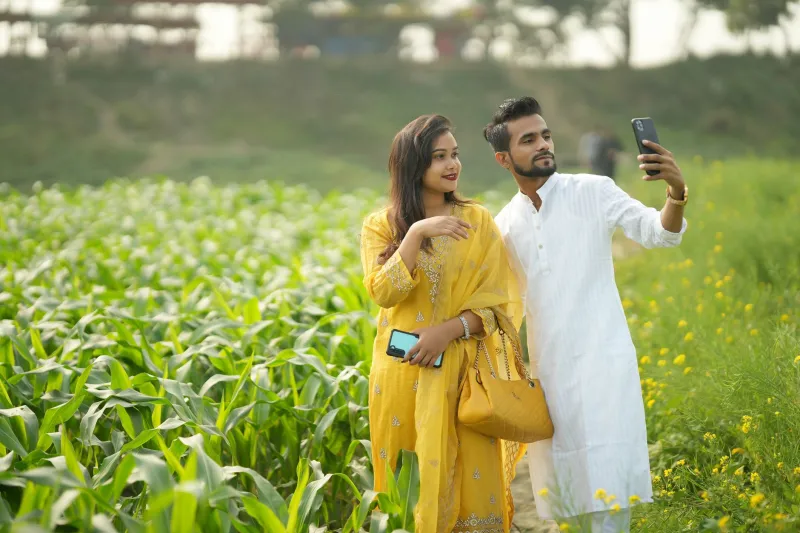
In a country where swipe-based dating apps have become the default infrastructure of romantic life, a quiet but consequential counter-movement is underway. Indian Muslim American entrepreneurs, many of them trained at elite engineering programs and seasoned in Silicon Valley culture, are building matrimonial platforms designed to do something Tinder and Hinge have never tried: honor the weight of community, faith, and family in the search for a life partner.
The platforms vary in their design philosophies—some are sleek and minimalist, others deliberately dense with profile fields that ask about madhab, parental background, and regional origin—but they share a common premise. The mainstream American dating market, for all its technological sophistication, was not built with them in mind.
The Limits of the Mainstream
For Indian Muslim Americans navigating marriage in the United States, the existing options have always felt inadequate. General-purpose apps like Bumble and Hinge are engineered around a set of cultural assumptions—casual exploration, individual autonomy, the primacy of physical attraction—that sit uncomfortably alongside Islamic principles of courtship and the community-centered logic of South Asian matrimonial tradition.
Broader Muslim dating apps, meanwhile, often fail to account for the specific textures of Indian Muslim identity: the distinctions between Bohra, Deobandi, and Barelvi communities; the significance of regional language and culinary culture; the layered negotiations between immigrant parents and American-raised children. A Pakistani American user and an Indian Muslim American user may share a faith but navigate marriage with fundamentally different cultural grammars.
"There is no platform that understands what it means to be from Hyderabad and living in Houston," said one entrepreneur who asked to be identified only by his first name, Zubair, while his app remains in beta testing. "The cultural specificity matters. It is not a niche—it is the whole point."
Building for Specificity
The platforms emerging from this community are notable for the deliberateness of their design choices. Several founders have spoken publicly about the months they spent conducting focus groups with Indian Muslim families across the country—in Fremont, California; in the Chicago suburbs; in the established South Asian corridors of New Jersey—before writing a single line of code.
What they found was a community in productive tension with itself. Younger users, many of them born or raised in the United States, wanted the efficiency and self-determination that digital tools afford. They were not opposed to technology. What they resisted was the cultural stripping that most mainstream apps perform—the reduction of a person to a photograph and a handful of prompts written for a secular, individualist audience.
Parents and community elders, for their part, expressed skepticism about any platform that removed them from the process entirely. In traditional Indian Muslim matrimonial culture, families are not peripheral to the search for a spouse—they are central to it. An app that privatizes the process and excludes parental input is not, from this vantage point, a neutral tool. It is a statement about whose judgment matters.
Several of the new platforms have responded to this tension with what might be called a family-integrated model. Rather than positioning the app as a one-on-one connection tool, these platforms allow parents to create and manage profiles on behalf of their children, with the child's consent and involvement. Communication features are designed to facilitate structured introductions rather than open-ended messaging. The language of the interface itself—terms like "wali involvement" and "halal interaction guidelines"—signals to users that the platform takes the ethical dimensions of Islamic courtship seriously.
The Business Case and Its Complications
Beyond the cultural mission, there is an undeniable business logic at work. The South Asian American matrimonial market is substantial, and the Indian Muslim segment within it is underserved in ways that represent a genuine commercial opportunity. Subscription models, premium matching services, and community event integrations have all been floated as revenue strategies.
But monetizing within a faith community introduces complications that secular app founders rarely confront. Charging for access to a spouse search can feel, to some community members, like commodifying a sacred process. Advertising partnerships raise questions about halal compliance. Data privacy concerns take on heightened significance in a community that has, with good reason, developed acute sensitivity about surveillance and profiling.
Founders navigating these concerns have spoken about the need to build trust before building revenue—a timeline that does not always align comfortably with investor expectations. Several have opted for community-backed funding models, raising capital from within Indian Muslim American networks rather than approaching mainstream venture capital firms whose partners may lack the cultural context to evaluate the product fairly.
Identity at the Interface
Perhaps the most revealing dimension of these platforms is what they expose about the ongoing negotiation of Indian Muslim American identity itself. Every design decision—which languages to support, whether to include sect-based filtering, how to handle interfaith inquiries, whether to display photographs—is simultaneously a technological choice and a statement about community values.
Some founders have described receiving sharp criticism from multiple directions at once. Progressive community members object to features that reinforce caste distinctions or privilege certain regional identities. Conservative voices push back against any design element that appears to give women unilateral control over the matching process, or that makes family involvement optional rather than default.
Navigating this terrain requires a kind of cultural fluency that no algorithm can fully encode. The most thoughtful platform builders seem to understand this. They speak not of solving the marriage problem but of creating a better container for a process that will always, ultimately, be human.
"Technology can lower the friction," said one founder who has been quietly piloting her platform within Indian Muslim communities in the Mid-Atlantic region. "It cannot replace the conversation that has to happen between two families, or the prayer that has to happen in the heart of the person searching. What we can do is make sure that when those things happen, they are happening between people who actually share a world."
What These Platforms Reveal
The rise of Indian Muslim American matrimonial technology is, at its core, a story about community self-determination. It reflects a generation unwilling to accept that the tools shaping their most intimate decisions should be built by people who neither know nor care about the specifics of their lives.
In this sense, these platforms are continuous with a broader pattern visible across Indian Muslim American civic life—the impulse to build institutions, spaces, and systems that reflect the community's own values rather than adapting, imperfectly, to structures designed for someone else.
Whether these ventures will achieve the scale their founders envision remains to be seen. The matrimonial technology space is littered with promising platforms that could not survive the gap between cultural resonance and sustainable revenue. But even if many of these apps do not endure in their current form, they are already performing a function that transcends their commercial fate: they are making visible, in code and interface and user experience, a community's insistence on being seen whole.