Sharing the Pandal: Why Indian Muslim Americans Are Showing Up for Durga Puja—and What It Means for Both Communities
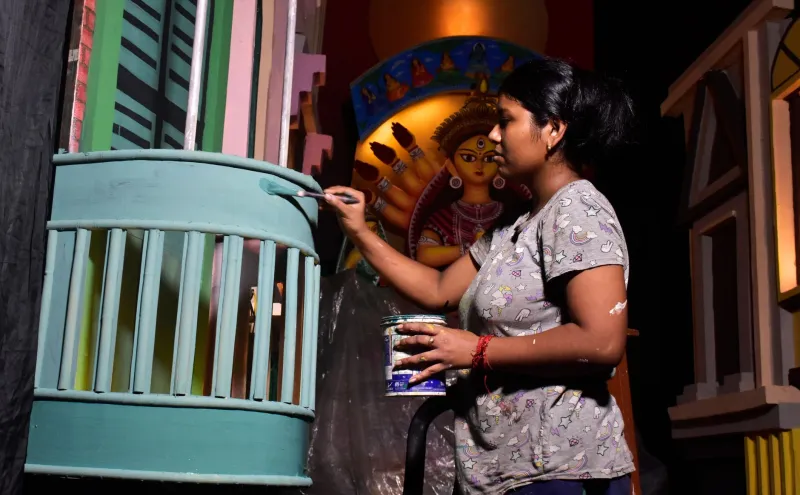
Every October, when the smell of dhunuchi incense drifts through community centers in Edison, New Jersey, and the dhak drums begin their familiar rhythm in suburban Chicago, something quietly remarkable happens. Alongside the Hindu Bengali families who have gathered to celebrate Durga Puja for generations, a smaller but increasingly visible group joins in: Indian Muslim Americans who consider these festivals not foreign ground but shared cultural inheritance.
For many outside observers—and even for some within the community—this participation raises genuine questions. What draws Muslim Americans toward a distinctly Hindu religious festival? What does their presence signal about the nature of Indian identity in America? And perhaps most importantly, can this kind of cross-religious engagement serve as a meaningful model for interfaith solidarity, or does it risk becoming something merely performative?
The answers, drawn from conversations with organizers, families, and community leaders across several American cities, are more layered—and more hopeful—than any simple narrative allows.
A Shared Cultural Grammar
For Farrukh Siddiqui, a software engineer who grew up in Kolkata and now lives in the Atlanta suburbs, Durga Puja was never primarily a religious event. It was the sound of autumn. It was new clothes, neighborhood lights, the particular electricity of a city transformed.
"In Kolkata, Durga Puja belongs to everyone," he says. "My Muslim neighbors, my Hindu friends—we all grew up counting down to it. When I came to America and saw the Bengali community here organizing pujas, it felt like home. I wasn't worshipping. I was remembering."
This distinction—between religious participation and cultural belonging—is central to how many Indian Muslim Americans articulate their engagement with Hindu festivals. They are not crossing a theological line so much as honoring a shared geography of memory. The subcontinent's pluralist traditions, however contested they have become in contemporary India, produced generations of people for whom festivals like Diwali, Durga Puja, and Eid were communal events rather than strictly sectarian ones.
In the American context, that shared grammar becomes even more significant. Separated from the political tensions that increasingly define Hindu-Muslim relations in India, diaspora communities have, in many cases, found space to recover an older model of coexistence.
Beyond Nostalgia: Active Allyship at the Pandal
But participation is not merely nostalgic. In several cities, Indian Muslim Americans have moved from attendees to active contributors—volunteering at festival logistics, donating to organizing committees, and in some cases serving on the planning boards of local Durga Puja associations.
Nadia Rahman, a community organizer based in the Chicago area who has worked with both Muslim advocacy groups and broader South Asian coalitions, sees this involvement as deliberate and politically conscious.
"After 2019, after the CAA protests, after everything that happened in India, many of us felt an urgency to build real relationships—not just symbolic ones," she explains. "Showing up at Durga Puja isn't just about cultural nostalgia for me. It's about saying to my Hindu neighbors: we are in this together. Our fates in this country are linked."
Rahman's framing points to something important. For Indian Muslim Americans navigating a post-9/11 America while simultaneously watching the erosion of Muslim civil rights in India, interfaith solidarity is not an abstract virtue. It is a practical strategy. Allies built through genuine cultural exchange are more likely to show up when advocacy is needed—at city council hearings, at congressional offices, at moments when the Muslim community requires a broader coalition.
Several Hindu American organizers have noticed and welcomed the shift. Priya Mukherjee, who helps coordinate a major Durga Puja celebration in the New York metropolitan area, says that Muslim participation has enriched her community's understanding of the festival's own pluralist roots.
"Durga Puja in Bengal was always a community festival. It was never meant to exclude anyone," she says. "When our Muslim friends and neighbors come, it feels like we are recovering something true about ourselves—something that gets lost in all the political noise."
Navigating Complexity: The Questions That Remain
Not everyone in the Indian Muslim American community views this engagement without reservation. Some scholars and community members raise legitimate questions about the asymmetry of interfaith outreach—noting that the burden of bridge-building often falls disproportionately on minority communities, who must demonstrate openness and goodwill while facing structural disadvantages.
There are also theological considerations that individual families navigate differently. Islamic scholars hold a range of views on participation in non-Muslim religious ceremonies, and families must find their own balance between cultural connection and religious conviction. For many, the line is clear: attending a cultural gathering, sharing food, celebrating community—these are acts of neighborliness. Active participation in religious rituals is a different matter, and most Indian Muslim Americans who engage with Durga Puja are careful to draw that distinction.
Imam Khalid Rasheed, who leads a mosque in northern Virginia with a significant Indian immigrant congregation, says he encourages his community members to engage with their Hindu neighbors on cultural terms while remaining grounded in their own faith identity.
"Islam has always recognized the dignity of other traditions," he says. "Visiting a neighbor's celebration, offering congratulations, sharing in the joy of a community event—these are expressions of good character. We do not abandon who we are by honoring who others are."
What American Soil Makes Possible
There is something specific to the American context that enables this kind of exchange in ways that have become increasingly difficult on the subcontinent itself. Distance from India's political climate—where Hindu-Muslim relations have been weaponized by nationalist movements on multiple sides—creates a different kind of freedom. Here, communities can choose to remember the India they came from rather than the India that is being constructed in real time.
That choice is itself a form of political statement. When Indian Muslim Americans show up at a pandal in Queens or a Diwali mela in Houston, they are asserting a version of Indian identity that refuses to accept the communal divisions being exported from abroad. They are saying, in effect, that Indianness is not the exclusive property of any single religion.
For younger Indian Muslim Americans born or raised in the United States, this stance feels both natural and necessary. Many grew up in diverse schools where their Hindu and Muslim classmates navigated American life together, and the idea of a hard wall between communities feels foreign to their experience.
"My best friend growing up was Hindu. We went to each other's houses for every holiday," says Zara Khan, a college student from New Jersey whose family regularly attends their local Durga Puja. "To me, that's just what being Indian American means. It means all of it belongs to you."
A Model Worth Replicating
The interfaith engagement visible at Durga Puja pandals across America is not a grand organized movement. It is, mostly, a collection of individual decisions made by families and community members who have chosen connection over distance. But that organic quality is precisely what gives it credibility and staying power.
For a community that is often asked to prove its loyalty, its Americanness, and its compatibility with pluralist values, this kind of lived solidarity offers something that no press release or advocacy campaign can manufacture. It demonstrates, in the most direct terms possible, that Indian Muslim Americans do not merely tolerate diversity—they embody it.
As the political climate in both the United States and India continues to test the bonds between communities, the simple act of showing up—of sharing a meal, watching a performance, standing together under the lights of a pandal—carries a weight that extends far beyond the festival itself.