Certified, Capitalized, and Contested: The Indian Muslim American Drive to Own the Halal Market
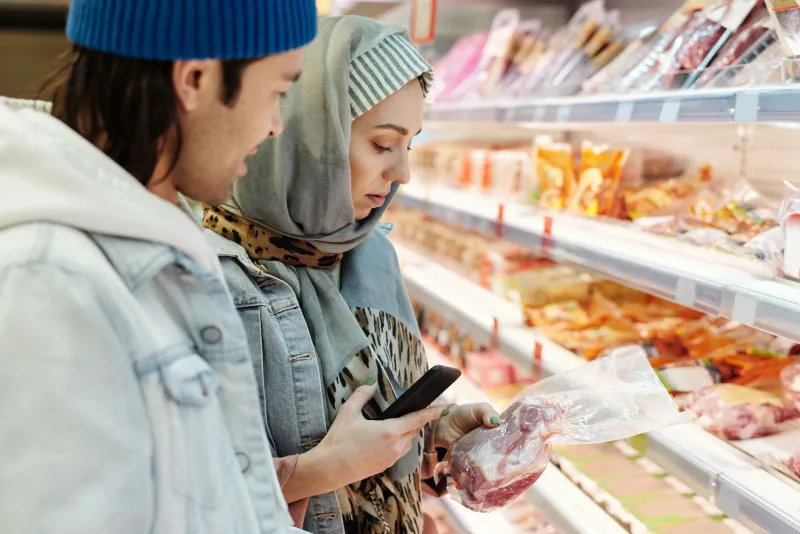
Walk into a Whole Foods in Dearborn, a Walmart Supercenter in Fremont, or a Costco outside of Houston, and you will find something that would have been nearly unimaginable two decades ago: an expanding halal food section stocked not merely with imported goods from the Middle East, but with products conceived, certified, and commercialized by American Muslim entrepreneurs — a growing number of them of South Asian origin. The halal food market in the United States is now estimated to exceed $5 billion annually, and that figure is climbing. Behind much of that growth is a generation of Indian Muslim Americans who have moved from niche catering operations and ethnic grocery stores into mainstream food production, venture-backed startups, and institutional distribution networks.
This is not simply a story about food. It is a story about economic sovereignty, religious legitimacy, and the contested question of who gets to define what it means to eat according to Islamic principles in America.
From Community Tables to Commercial Shelves
For most of the twentieth century, halal food in America was a community affair — managed through mosque butcher programs, informal networks of trusted vendors, and small family-owned businesses serving immigrant neighborhoods. Indian Muslim families arriving in the post-1965 immigration wave largely participated in this informal economy, supplementing it with products brought from home or sourced through Middle Eastern grocery distributors.
The shift began gradually in the 1990s and accelerated sharply after 2010, when a combination of demographic growth, increased Muslim consumer awareness, and mainstream retail interest converged. Indian Muslim entrepreneurs — many of them children of the same immigrants who once relied on informal supply chains — began applying professional expertise to a market that had long operated without institutional infrastructure. Food scientists, supply chain managers, marketing executives, and attorneys with roots in communities like those in New Jersey, Texas, Illinois, and California began founding halal food companies with real capitalization and national ambitions.
Companies such as Saffron Road, founded with South Asian Muslim leadership, demonstrated that halal-certified frozen entrées could compete on flavor, packaging, and price with mainstream brands. That proof of concept opened doors — and checkbooks.
The Certification Labyrinth
At the center of the halal economy is a system that is simultaneously its greatest asset and its most persistent source of controversy: certification. Unlike kosher food, which operates under a relatively consolidated and recognized set of certifying bodies, halal certification in the United States is fragmented across dozens of organizations, each with its own standards, fees, and theological interpretations.
For Indian Muslim American entrepreneurs, navigating this labyrinth is often the first major operational challenge. Some certifying bodies are rooted in South Asian jurisprudential traditions — particularly Hanafi scholarship — while others follow Gulf-influenced standards or more stringent interpretations that may disqualify certain stunning practices or ingredient sourcing methods. The choice of certifier is not merely a business decision; it is a statement of religious alignment that carries weight with specific consumer communities.
"You are not just picking an auditor," explained one Indian Muslim food entrepreneur based in New Jersey who asked to remain anonymous due to ongoing business negotiations. "You are picking a theology. And different communities trust different certifiers. That choice affects your market reach in ways that have nothing to do with the quality of your product."
This fragmentation has created both opportunity and tension. Several Indian Muslim American investors and legal professionals have moved into the certification space itself, founding or funding organizations that aim to bring greater standardization and transparency to the process. Critics within the community, however, worry that commercializing certification risks subordinating religious integrity to market incentives — a concern that echoes debates happening simultaneously in the kosher and organic food industries.
Capital Meets Conviction
Perhaps the most significant development in the halal economy over the past five years has been the arrival of serious institutional capital. Angel investors, family offices, and early-stage venture funds with ties to the Indian Muslim American professional community have begun directing resources toward halal food ventures in ways that were rare a decade ago.
This capital is enabling a new class of halal entrepreneur to pursue ambitions far beyond the ethnic grocery aisle. Halal meal kit services, plant-based protein companies targeting Muslim consumers, halal-certified fast casual restaurant chains, and direct-to-consumer meat delivery platforms have all attracted funding from within the community. The thesis is straightforward: a Muslim American population that now exceeds three million people, combined with growing non-Muslim consumer interest in ethically sourced protein, creates a substantial and underserved market.
But the infusion of capital has also intensified competition and, in some quarters, raised uncomfortable questions. As halal food becomes a viable investment category, the risk that authenticity becomes a marketing posture rather than a lived commitment grows proportionally. Some community scholars and advocates have begun calling for greater consumer education and independent oversight to ensure that certification standards do not erode under commercial pressure.
A Proxy Battle Over Islamic Authenticity
Beneath the spreadsheets and supply chain negotiations, the halal economy in America is also a site of genuine theological and cultural contestation. Indian Muslim Americans occupy a particular position in this debate. As a community that carries with it a distinct Subcontinental jurisprudential heritage — shaped by centuries of Hanafi scholarship, Sufi tradition, and the particular experience of being a religious minority in a Hindu-majority nation — their approach to halal standards sometimes diverges from that of Arab American or African American Muslim communities.
These differences are not merely academic. They surface in debates over whether machine-slaughtered chicken meets halal requirements, whether certain food additives derived from ambiguous sources are permissible, and whether the social conditions of food production — labor practices, environmental impact, animal welfare — should factor into halal standards at all. Progressive voices within the Indian Muslim American community have been among the most vocal in arguing that a genuinely Islamic approach to food must encompass justice across the entire supply chain, not merely the moment of slaughter.
This broader conception of halal — one that aligns with progressive values around labor rights and environmental stewardship — is gaining traction among younger Indian Muslim American consumers who are simultaneously more religiously literate and more socially conscious than previous generations. Entrepreneurs who have internalized this expanded framework are beginning to build it into their brand identities, distinguishing themselves from competitors who treat certification as a checkbox rather than a commitment.
What the Market Reveals
The halal economy, viewed through the lens of the Indian Muslim American experience, is ultimately a mirror of the community's broader aspirations and contradictions. It reflects a people who have achieved significant professional and financial success in America and are now deploying that success in service of religious and cultural self-determination. It also reflects a community still working through questions of authority, representation, and values that do not resolve neatly in a marketplace.
What is clear is that Indian Muslim Americans are no longer peripheral actors in this story. They are founders, funders, certifiers, and consumers shaping an industry that feeds millions and carries meaning that no balance sheet can fully capture. The halal economy is growing. The harder question — who it will ultimately serve, and on whose terms — remains beautifully, urgently open.