Who Holds the Keys? Inside the Battle to Reimagine Indian Muslim American Mosque Governance
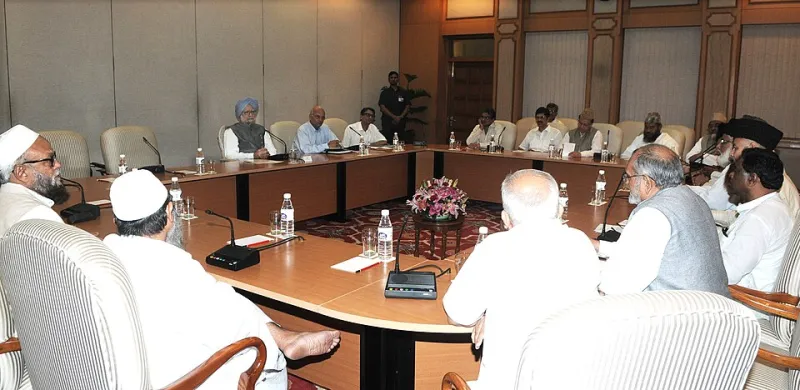
Photo: Prime Minister's Office, GODL-India, via Wikimedia Commons
On a cold Saturday morning in northern New Jersey, roughly forty members of a prominent Indian Muslim community center crowded into a basement meeting room that smelled of chai and old carpet. The agenda, distributed via a WhatsApp group that had been running hot for weeks, listed a single item: a vote on whether to mandate independent financial audits for the organization's $2.3 million annual budget. By the time the meeting ended — three hours and several raised voices later — no vote had been taken. The board chair, a founding member who had helped build the center from a rented church hall in the early 1990s, had invoked a procedural clause that effectively tabled the motion indefinitely.
No one left satisfied. And almost no one was surprised.
Scenes like this are playing out with increasing frequency inside Indian Muslim American institutions — mosques, cultural associations, and Islamic schools that were built by first-generation immigrants and are now being inherited, and contested, by their American-born children and grandchildren. The disputes rarely make headlines. They are adjudicated not in courtrooms but in parking lots, email chains, and tense after-Jumu'ah conversations. Yet they carry stakes that extend well beyond any single organization.
The Architecture of the Old Guard
To understand the current tensions, it helps to understand how most of these institutions were built. Indian Muslim immigrants who arrived in the United States after the Immigration and Nationality Act of 1965 were, in many cases, professionals — engineers, physicians, academics — who brought with them not only technical expertise but also deeply ingrained assumptions about authority and community leadership. Organizational structures were often informal, centralized around a small group of founding donors whose financial contributions translated directly into decision-making power. Bylaws, when they existed at all, were frequently modeled on loose templates with little accountability infrastructure.
This was not cynicism. It was survival. These communities were small, underfunded, and operating in an environment where the primary challenge was simply sustaining a space for prayer and cultural continuity. Efficiency mattered more than process. Trust was personal, not institutional.
Decades later, those informal arrangements have calcified into something that younger members increasingly experience as opacity. Financial records are difficult to access. Board elections, where they exist, are sometimes conducted without clear voter rolls or term limits. Major expenditures — construction contracts, speaker invitations, programmatic decisions — are made by small committees with minimal community consultation.
The Reform Generation
The pushback is being led, in most cases, by American-educated professionals in their thirties and forties who have spent their careers navigating corporate compliance structures, nonprofit governance frameworks, and civic institutions that operate under formal accountability mechanisms. They are not radicals. They are, in many respects, deeply conservative in their attachment to the community. But they arrive at the mosque with a different set of expectations.
"I serve on a nonprofit board for my day job," said one second-generation Indian Muslim woman who has been involved in a governance reform effort at a mosque in the Chicago suburbs. She asked not to be identified by name to avoid further conflict within her community. "We have audits. We have conflict-of-interest policies. We have term limits. I come to my masjid and none of that exists. And when I ask why, I'm told that's not how things are done here. That's not an answer."
The specific demands vary by institution, but common themes emerge: independent financial audits, transparent budget publication, formalized election procedures, term limits for board positions, and clear grievance mechanisms. These are not radical propositions. They are standard features of any well-governed American nonprofit organization.
What makes them politically charged within Indian Muslim communities is not the substance but the subtext. For many founding-generation leaders, a demand for institutional accountability reads as a challenge to personal honor — an implication that they have been untrustworthy stewards of community resources. For younger reformers, the resistance to transparency reads as confirmation that something is being protected.
Both interpretations may be partially correct. Both are making productive conversation difficult.
When Reform Becomes a Referendum
In at least three documented cases across Texas, California, and the mid-Atlantic region — situations described to Bhartiya Muslim by participants who requested anonymity — governance disputes have escalated to the point of community schism, with dissident factions forming alternative organizations or affiliating with other local mosques. In one Texas case, a dispute over construction contract transparency led to a formal legal challenge over the legitimacy of a board election. The litigation lasted eighteen months and cost the community an estimated $80,000 in legal fees — money that, all parties agreed, could have built a library wing.
The legal dimension is significant. American courts have historically been reluctant to intervene in the internal governance of religious organizations, citing First Amendment protections. But when disputes involve financial misconduct allegations or procedural violations of an organization's own bylaws, courts have occasionally stepped in. This creates a paradox: the very American legal framework that protects religious autonomy also creates a venue for internal conflicts to become expensive, public, and damaging.
Some institutions have navigated this terrain more successfully. A mosque in the greater Atlanta area underwent a comprehensive governance restructuring in 2021, adopting a new constitution with mandatory term limits, a community-elected oversight council, and quarterly financial reporting published to all dues-paying members. The process took two years and involved facilitated mediation sessions. The founding generation, to their credit, ultimately supported the changes — a decision that several of them described as difficult but necessary.
"We built this for our children," one founding board member told Bhartiya Muslim. "If our children can't trust the institution, then we failed at the most important part."
Democracy as a Muslim Value
There is a theological dimension to this conversation that often goes unacknowledged in the procedural debates. Islamic tradition has rich resources for concepts of shura — consultative governance — and amanah, the principle of trust and accountability in stewardship. Scholars within the American Muslim community have increasingly argued that transparent, democratic institutional governance is not a Western imposition but an expression of core Islamic values applied to contemporary organizational life.
This framing has proven useful in some communities, providing reformers with a language that does not position them as cultural apostates but as faithful stewards of principles their elders also hold dear. Whether that framing gains broader traction may depend on how willing institutional leaders are to receive it.
The Stakes Beyond the Ballot Box
For the Indian Muslim American community, these internal governance struggles carry implications that extend into the political sphere. Mosques and community organizations are not merely spiritual spaces — they are civic infrastructure. They are where voter registration drives are organized, where candidates seek endorsements, where community members learn the mechanics of collective action. Institutions that operate without democratic accountability produce communities that are less prepared to engage democratic politics effectively.
The mosque board wars, for all their apparent insularity, are ultimately a rehearsal for citizenship. How Indian Muslim Americans resolve the tension between inherited authority and democratic expectation will shape not only their internal community life but their capacity to exercise power in the broader American political landscape.
The keys, in other words, are not just to the building. They are to the future.